In geopolitics, timing is rarely accidental. In this analysis article that I am writing, “Trump’s Venezuela Gambit and the Global Power Triangle,” chaos is often choreography, and what appears impulsive is frequently a calculated bluff. As an analyst, I approach the opening weeks of January 2026 as a poker table where three major players – the United States, Russia, and China – are reading each other’s hands under extreme pressure.
The Epstein files, Venezuela, Greenland, oil markets, and approval ratings are not isolated stories; they are chips being pushed into the center of the table. What follows is not a moral judgment, but a strategic reading of the game.
The Timing Is Never Coincidental: Epstein Files as Political Cover
The temporal convergence of events in early January 2026 reveals a calculated political strategy. Trump’s administration faced mounting political pressure as the Epstein Files Transparency Act deadline approached in late 2025, with the Justice Department’s piecemeal document releases drawing criticism from both Republicans and Democrats, while Trump’s approval ratings sank to historic lows.
Trump’s approval rating plummeted from a net positive of +6 in January 2025 to -12 by December, with polling showing only 36-40% approval—the lowest for any president at the end of their first year in five decades.
The Venezuela operation, executed on January 3, 2026, provided a dramatic narrative shift. The U.S. military conducted large-scale strikes on Venezuela, capturing President Nicolás Maduro and his wife, with Trump announcing the U.S. would “run” Venezuela until a proper transition could occur. Whether intentional or opportunistic, this military action dominated news cycles precisely when the most damaging Epstein document releases were emerging.
The strategic distraction hypothesis gains credence when examining the political calculus: a president facing domestic scandals redirecting public attention through bold foreign policy action is a time-tested political maneuver.
The Geopolitical Chess Match: Venezuela as Opening Gambit
Trump’s Venezuela intervention represents sophisticated strategic signaling rather than impulsive militarism.
The Venezuela operation’s true audience extends far beyond Caracas – it’s a message to Moscow, a warning to Beijing, and a demonstration to European allies of American resolve under unpredictable leadership.
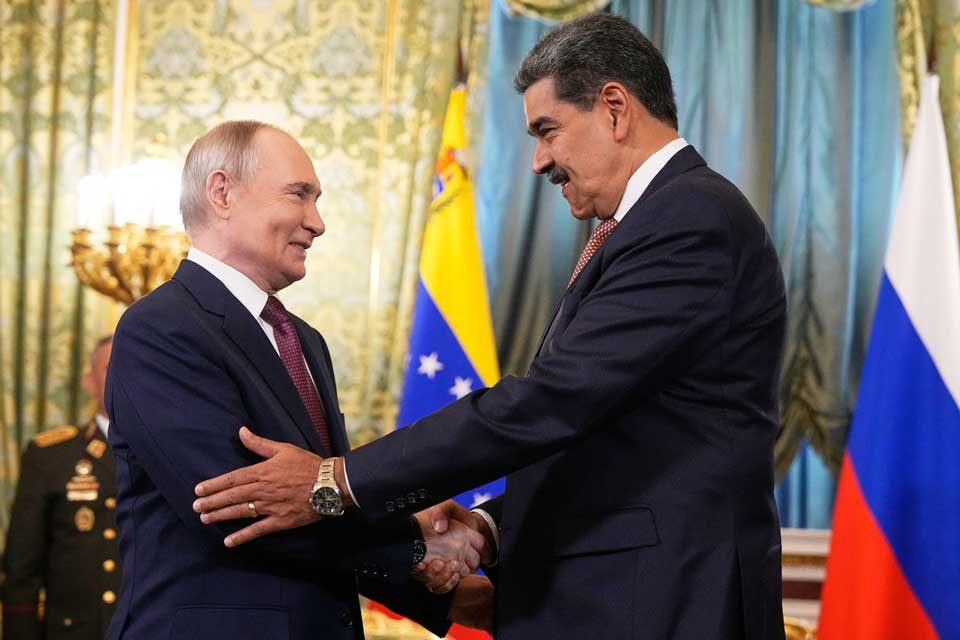
Pressuring Putin Where It Hurts: Oil, Allies, and Time
Russia enters 2026 under severe strain: weak GDP growth, oil prices far below budget assumptions, falling energy revenues, expanding sanctions, and refinery damage from Ukrainian drone strikes. Venezuela matters here because restoring its oil production under U.S.-friendly governance threatens to flood already soft global markets.
This is asymmetric warfare by economic means. Lower oil prices do not merely reduce Russian revenue – they compress Putin’s strategic timeline. The more the oil supply increases, the faster Moscow bleeds cash, and the narrower its room to maneuver becomes.
Trump’s move does not collapse Russia – but it accelerates pressure at a moment when Putin can least absorb it. And that Putin Hybrid war now in USA backyard is coming to an end
Greenland: Strategic Absurdity or Calculated Brinkmanship?
Trump’s parallel escalation over Greenland appears irrational on the surface—threatening a democratic NATO ally. But viewed through a poker lens, it serves a psychological function.
By floating the impossible, Trump reframes the improbable as reasonable. Venezuela then looks restrained. Cuba looks moderate. Sanctions look diplomatic.
This tactic is dangerous. Unlike Venezuela, Greenland is not a weak state. Denmark’s intelligence services now openly assess the U.S. as a security risk, and European leaders no longer dismiss Trump’s rhetoric as harmless theatrics. The Venezuela operation made prior bluffs suddenly credible.
The risk is that bluff becomes miscalculation. And that work with European allies is now inevitable.
The Approval Rating Paradox: Domestic Vulnerability Drives Foreign Aggression
Recent polling shows Trump’s approval rising slightly to 42% in early January 2026 from 39% in December, marking his highest rating since October, though he remains deeply underwater overall. Early polling on the Venezuela operation shows Americans evenly divided, with 33% approving and 34% disapproving.
This marginal improvement masks profound political weakness. Trump’s approval among independents collapsed from -1 in January 2025 to -43 by December—a 42-point decline – while even his MAGA base saw “strong approval” drop from 78% to 70%. The economic anxiety driving these numbers – inflation concerns, cost of living increases, and dissatisfaction with trade policies – creates political incentives for dramatic foreign policy “wins” to compensate for domestic failures.
The historical pattern is clear: domestically vulnerable presidents often seek foreign policy victories. Trump’s situation is particularly acute given multiple compounding pressures: the Epstein files controversy, persistent economic anxiety despite low unemployment, and growing Republican unease over governance style.
The Chinese Long Game: Economic Dominance Through Strategic Patience
While Trump and Putin engage in confrontational geopolitics, China pursues structural power accumulation. China’s 15th Five-Year Plan prioritizes “high-quality development” with a focus on advanced manufacturing, AI, and technology self-sufficiency, with Chinese R&D spending expected to surpass that of the United States in 2026. Chinese exports captured 15% of global market share in 2025, with robust 8% growth despite protectionist headwinds, while exports to the U.S. now represent less than 10% of total exports.
Beijing’s strategy represents a sophisticated understanding of 21st-century power dynamics: economic integration creates dependency more effectively than military coercion. Xi Jinping frames technology as “the cornerstone of a strong nation,” pursuing dominance in global supply chains through indigenous R&D, supply chain resilience, and advanced manufacturing across AI, robotics, quantum computing, and 6G technologies.
The Chinese model bypasses Trump-Putin confrontation entirely. While Russia burns reserves funding territorial expansion and America oscillates between intervention and isolation, China positions itself to capture developing economies through cost-effective technology offerings, potentially capitalizing on any AI bubble burst that could force Western companies toward expensive premium markets while Chinese alternatives penetrate underserved sectors.
The Business Community Constraint: Economic Reality as Political Guardrail
This analysis correctly identifies the fundamental constraint on Trump’s expansionist rhetoric: American business interests. The U.S. tech sector’s global dominance depends on international cooperation, open markets, and regulatory predictability — all threatened by unpredictable military interventionism.
American international leadership in business, science, economics, and technology faces unprecedented challenges from China’s systematic industrial policy. European markets represent critical revenue streams for American tech giants.
Any perception that the U.S. has abandoned rule-of-law international norms risks accelerating the shift toward Chinese technology ecosystems, particularly in the Global South, where diminishing international assistance increases appetite for budget-friendly Chinese AI and technology integration.
The stock market represents an immediate feedback mechanism constraining presidential adventurism. Major tech companies – Apple, Google, Microsoft, Meta – derive substantial revenue from international markets.
European regulatory hostility or Chinese market restrictions could destroy hundreds of billions in shareholder value instantly.
These corporations wield power “above Trump’s pay grade” through direct political influence, lobbying, and the implicit threat that economic collapse means political collapse.
NATO and Democratic Norms: The Institutional Binding
The Greenland threat reveals the ultimate constraint on Trump’s poker game: institutional resilience of democratic systems. Denmark and Greenland’s prime ministers firmly rejected Trump’s annexation rhetoric, with European leaders issuing joint statements affirming “Greenland belongs to its people” and warning that any U.S. attack on a NATO ally would end the alliance itself.
American democracy, despite current strains, retains institutional checks. Congress holds war powers, courts enforce constitutional limits, and civil society mobilizes against authoritarian overreach. The Venezuela operation already triggered Democratic leaders’ warnings about constitutional responsibility and protecting democratic norms, with concerns about setting dangerous precedents that could justify Russian actions in Ukraine or Chinese moves toward Taiwan.
Greenland annexation would require either:
- Democratic consent through referendum (extremely unlikely given local opposition)
- Military occupation of a NATO ally (triggering alliance collapse and potential U.S. military mutiny)
- Economic coercion so severe it would destroy transatlantic relations
None is politically sustainable. American military officers swear oaths to the Constitution, not presidential orders. Significant portions of the Pentagon would refuse orders to invade a democratic ally. The resulting constitutional crisis would make Trump’s current approval problems look trivial.
The Russian Economic Collapse Timeline: Putin’s Closing Window
Economists warn Russia faces its worst economic situation since the war began, having burned through cash reserves and borrowed money that fueled wartime spending, with a possible banking crisis in 2026 as the question becomes which “clock runs out first”. While Russia can continue financing the war by drawing heavily on foreign reserves and the sovereign wealth fund, actual military spending will significantly exceed budget figures, with Ukraine’s drone strikes reducing Russian refinery capacity by 10-38%.
Putin faces a strategic vise: The war-of-choice with Ukraine has intensified Russia’s pre-war weaknesses – an underperforming economy, fragile demographics further hollowed by casualties and emigration, and deepening subordination to China through discounted energy sales and technology dependence. The irony is stark—fighting to keep Ukraine from Western integration locks Russia into Chinese vassal status.
Trump’s Venezuela gambit threatens to accelerate Russia’s economic timeline by flooding oil markets, potentially forcing Putin toward negotiations not from a position of strength but economic desperation. However, Russia’s war economy is not collapsing, but neither is it stable, with China and India as essential buyers, slowing fiscal pressures, while tighter sanctions constrain access to advanced technology.
The Failed Bluff: Why Trump’s Poker Analogy Misunderstands Power
Characterization of Trump as “poker player” rather than dictator contains profound truth: he operates within democratic constraints while projecting authoritarian bravado. However, effective poker requires credibility—opponents must believe you’ll execute threats.
The Venezuela operation established credibility for some threats while exposing the limits of others. Invading a failing narco-state with bipartisan elite consensus for regime change demonstrates capability. Annexing a prosperous democratic NATO ally represents an impossibility masquerading as a threat.
Putin probably understands this distinction. Putin carefully avoids provoking Trump over Venezuela, recognizing the U.S. president’s unpredictability and willingness to use military force, while Trump’s sanctions on Russian oil companies deliver serious blows to the teetering Russian economy if rigorously enforced. The implicit negotiation involves Russian concessions in Ukraine in exchange for American restraint elsewhere—not because Trump can execute maximalist threats, but because economic warfare (sanctions, oil prices, technology restrictions) inflicts real damage without military action.
Three Powers, Three Strategies, One Uncertain Future
The global power triangle exhibits distinct strategic approaches:
Russia: Declining power pursuing territorial expansion through military force, burning finite resources to maintain great power status while economic fundamentals collapse. Putin’s strategy depends on Western exhaustion rather than Russian strength—a fundamentally defensive posture despite offensive operations.
United States: Schizophrenic power oscillating between internationalist engagement and nationalist retreat, wielding enormous capabilities through increasingly erratic execution. Trump’s poker game works only while opponents believe both in American power projection and sufficient institutional restraint to prevent civilizational rupture.
China: Rising power pursuing systematic economic dominance through patient infrastructure development, technology advancement, and market penetration. Beijing avoids direct confrontation while accumulating structural advantages that compound over the decades.
Trump’s domestic support is waning, with persistent public disapproval of economic handling and flagship policies, while his ability to govern effectively—including foreign policy pursuit—depends partly on standing with the American public. The approval rating trajectory suggests limited time for dramatic foreign policy gambits before political capital is exhausted entirely.
The Venezuela operation and Greenland threats represent high-stakes geopolitical signaling constrained by economic reality, democratic institutions, and alliance structures. Trump can disrupt—perhaps catastrophically—but cannot fundamentally reshape the international order without destroying the American economic and political systems that enable power projection.
Assessment that “Trump will fail too” gains support from historical patterns: presidents who overreach in foreign policy to compensate for domestic weakness typically accelerate rather than reverse political decline. Congressional concerns about dangerous precedents, combined with public division over the Venezuela operation, suggest limited appetite for further military adventures.
The ultimate constraint on Trump’s geopolitical poker remains unchanged: American democracy, for all its current dysfunction, retains sufficient institutional resilience to prevent authoritarian transformation. The question is not whether Trump can execute maximalist expansion—he cannot—but whether the attempt to project such capability damages American power more than it intimidates adversaries.
In this three-player game, China’s patient strategy of economic dominance through systemic integration may ultimately prevail over both Russian military desperation and American erratic assertiveness. The “poker game” metaphor fails because international relations is not zero-sum gambling but iterative cooperation and competition where long-term institutional strength determines outcomes more than short-term tactical brilliance.
Will Trump win this game? I’m not sure that there will be any winner in this game, but one thing is clear, and that is that the year 2026 will be very interesting for analysis and that Russia is in big problems now.


 Serbian
  English